 Granbo Ultrasonic








Choosing the Right Ultrasonic Cleaning Machine for Hardware Components
Browse Volume:61 Classify:Support
Hardware components accumulate stubborn contaminants that compromise performance and longevity. Metal shavings, cutting fluids, rust, grease, and oxidation layers create invisible barriers that affect everything from thread engagement to electrical conductivity. Professional workshops and manufacturing facilities have discovered that ultrasonic cleaning technology removes these contaminants more thoroughly than any manual method, reaching into blind holes, threads, and microscopic surface irregularities that brushes and solvents cannot touch.
The market offers dozens of ultrasonic cleaning machines, each claiming superior performance. However, selecting the wrong unit wastes money and fails to meet your specific hardware cleaning requirements.
What Makes Ultrasonic Cleaning Essential for Hardware
Ultrasonic cleaning has transformed from a luxury into a necessity for anyone serious about hardware maintenance and preparation. The technology delivers consistent results that manual cleaning simply cannot match, particularly when dealing with complex geometries or precision tolerances.
The Science Behind Ultrasonic Technology
Ultrasonic cleaners generate high-frequency sound waves, typically between 20 kHz and 40 kHz, through transducers attached to the tank bottom or sides. These sound waves create alternating high-pressure and low-pressure cycles in the cleaning solution. During low-pressure cycles, microscopic bubbles form throughout the liquid, a phenomenon called cavitation.
When these bubbles collapse during high-pressure cycles, they release tremendous localized energy. The implosion creates micro-jets of liquid traveling at speeds exceeding 100 meters per second. These jets penetrate every surface irregularity, dislodging contaminants at the molecular level. The process occurs millions of times per second across every submerged surface simultaneously.
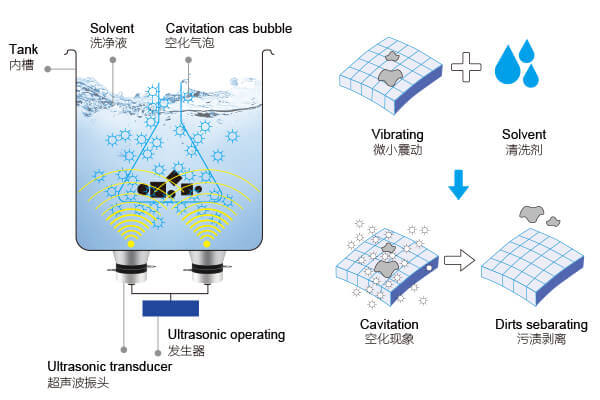
The Principle Behind Ultrasonic Cleaning
Temperature enhances this mechanical action. Heated solutions reduce surface tension, allowing cavitation bubbles to form more readily and collapse more violently. Most hardware cleaning applications perform optimally between 50°C and 65°C, though specific requirements vary based on contaminant type and hardware material.
Why Traditional Cleaning Methods Fall Short
Manual scrubbing with brushes and solvents represents the old standard for hardware cleaning. This approach suffers from fundamental limitations that become apparent when compared against ultrasonic technology. Brushes cannot reach into threaded holes smaller than 3mm diameter. Solvent baths require extended soaking times, often 30 minutes or longer, and still leave residues in complex geometries.
Spray washing systems use pressure to force cleaning solution against surfaces. While effective for large, simple parts, these systems struggle with small hardware. The spray cannot generate sufficient pressure inside narrow channels without damaging delicate components. Water consumption reaches excessive levels, and drying becomes problematic for parts with internal cavities.
Ultrasonic cleaning addresses all these shortcomings. A five-minute ultrasonic cycle typically removes more contamination than 30 minutes of manual scrubbing. The process reaches every surface simultaneously, including areas completely inaccessible to brushes or sprays. Delicate components remain undamaged because the cleaning action occurs at the microscopic level rather than through mechanical abrasion.
Types of Ultrasonic Cleaners for Hardware Applications
Understanding the different categories of ultrasonic cleaners helps narrow your selection before examining specific features. Each type serves distinct applications and workspace configurations.
Desktop Models for Small Workshops
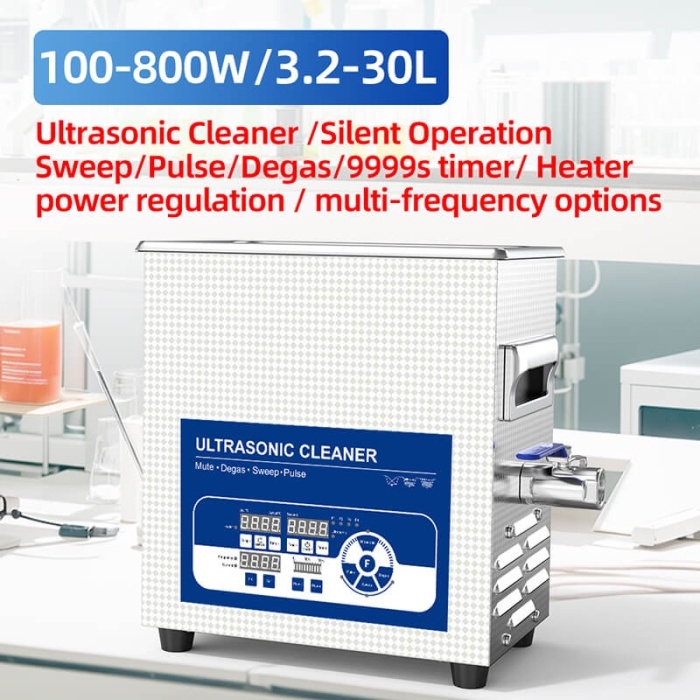
Desktop ultrasonic cleaners feature tank capacities between 0.6 liters and 10 liters. These compact units fit on standard workbenches and operate from household electrical outlets. Most desktop models generate between 50 and 200 watts of ultrasonic power, adequate for cleaning small batches of fasteners, hand tools, and electronic components.
A typical 3-liter desktop unit measures approximately 300mm x 240mm x 200mm and weighs around 5 kilograms when empty. This size accommodates standard parts baskets measuring 250mm x 180mm x 100mm, sufficient for several hundred small screws or dozens of larger hardware items per cycle. The power consumption rarely exceeds 300 watts including heating elements, making these units economical for intermittent use.
Desktop cleaners serve hobbyists, small repair shops, and maintenance departments handling occasional cleaning tasks. The lower purchase price, typically between $150 and $800 depending on features, makes them accessible for operations without continuous cleaning requirements. However, their limited capacity and power restrict commercial applications requiring high throughput.
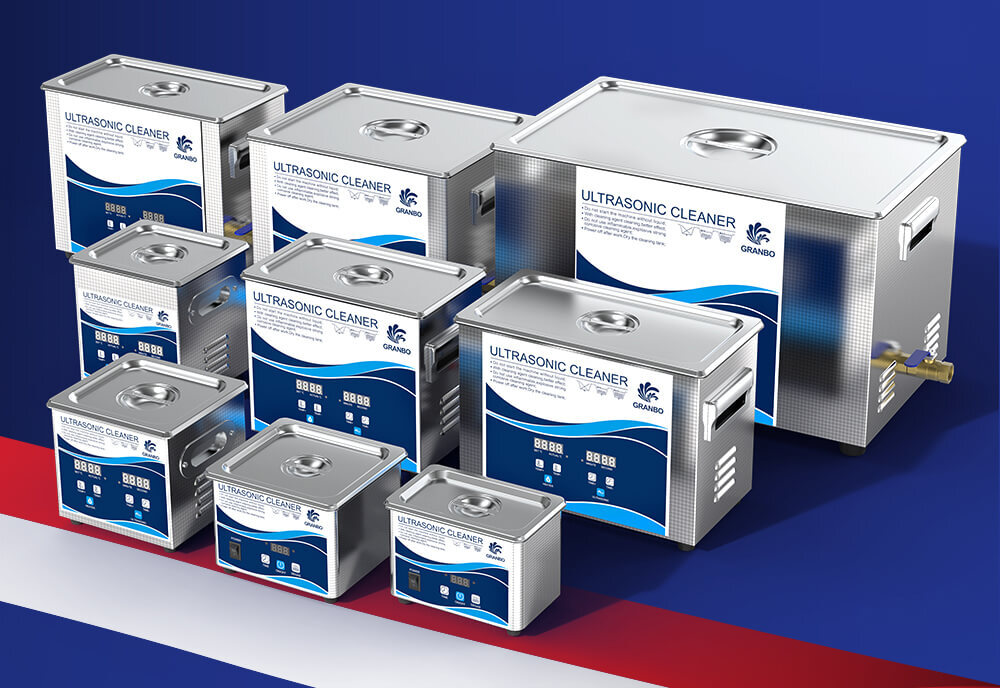
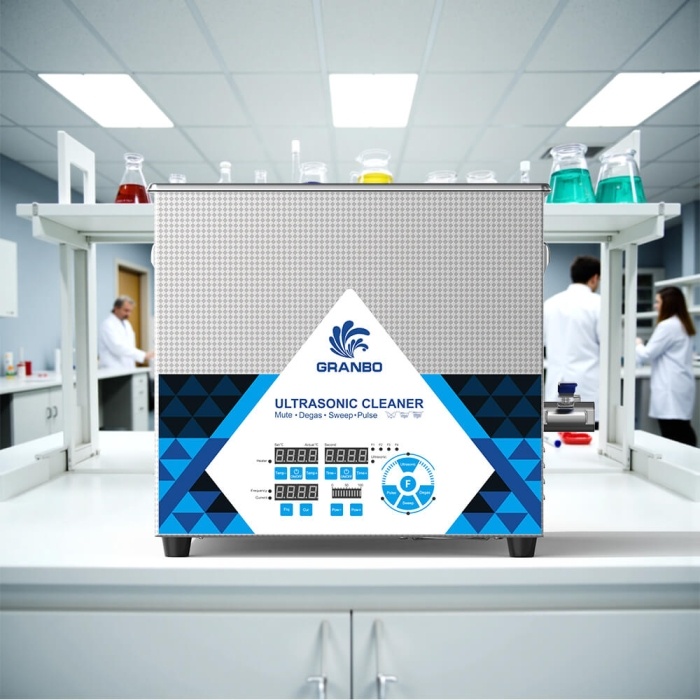
Click to View:Compact tabletop ultrasonic cleaner
Industrial Grade Systems for Manufacturing
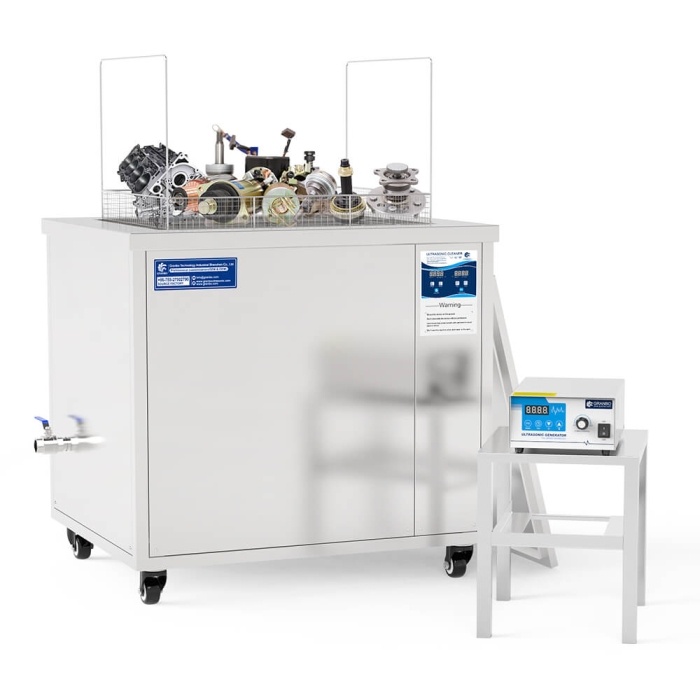
Industrial ultrasonic cleaners range from 20-liter benchtop units to 500-liter floor-standing systems. These machines deliver ultrasonic power between 500 watts and 3000 watts, enabling rapid cleaning of larger parts or high-volume batch processing. Construction quality exceeds desktop models, with stainless steel tanks rated for continuous operation and commercial-grade transducers designed for 10,000-hour service lives.
A 50-liter industrial system typically measures 800mm x 600mm x 600mm and requires dedicated 220V electrical service. These units clean entire engine blocks, transmission housings, or batches containing thousands of small fasteners simultaneously. Heating systems bring 50 liters of solution from room temperature to 60°C in approximately 25 minutes, then maintain temperature automatically throughout multiple cleaning cycles.
Manufacturing facilities processing hundreds or thousands of hardware components daily require industrial capacity. The increased upfront cost, ranging from $2,000 to $15,000 for mid-range systems, becomes justified through labor savings and improved cleaning consistency. Many industrial models include programmable controls, automatic solution circulation, and integration capabilities with production line automation.
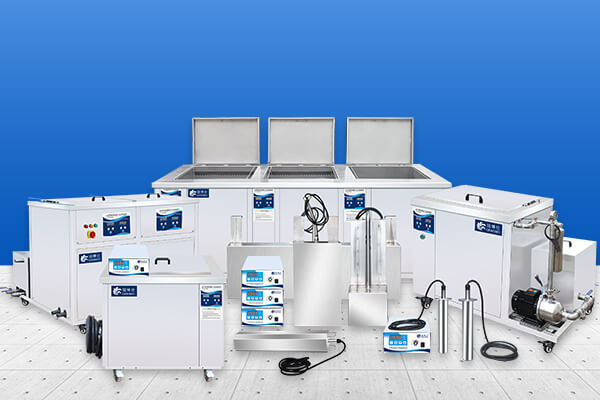
Click to View:Industrial Ultrasonic Cleaner
Specialized Units for Precision Components
Certain hardware applications demand specialized ultrasonic cleaners optimized for specific requirements. Multi-frequency systems operate at two or more frequencies, typically 25 kHz for heavy contamination removal and 40 kHz for final precision cleaning. Switching between frequencies during a single cycle provides aggressive initial cleaning followed by gentle final processing.
Swept-frequency technology modulates the operating frequency continuously across a narrow band, eliminating standing wave patterns that create dead zones in fixed-frequency cleaners. This ensures uniform cleaning across the entire tank volume, critical when processing precision components with tight tolerance specifications. These systems cost 20% to 40% more than standard fixed-frequency units but deliver measurably superior results for demanding applications.
Degassing-capable units remove dissolved air from cleaning solutions before processing begins. Air bubbles cushion cavitation intensity, reducing cleaning effectiveness. Degassing cycles run for 5 to 10 minutes, creating optimal conditions for cleaning precision hardware with microscopic surface finishes. Watchmakers, electronics manufacturers, and aerospace component processors commonly specify degassing capability.
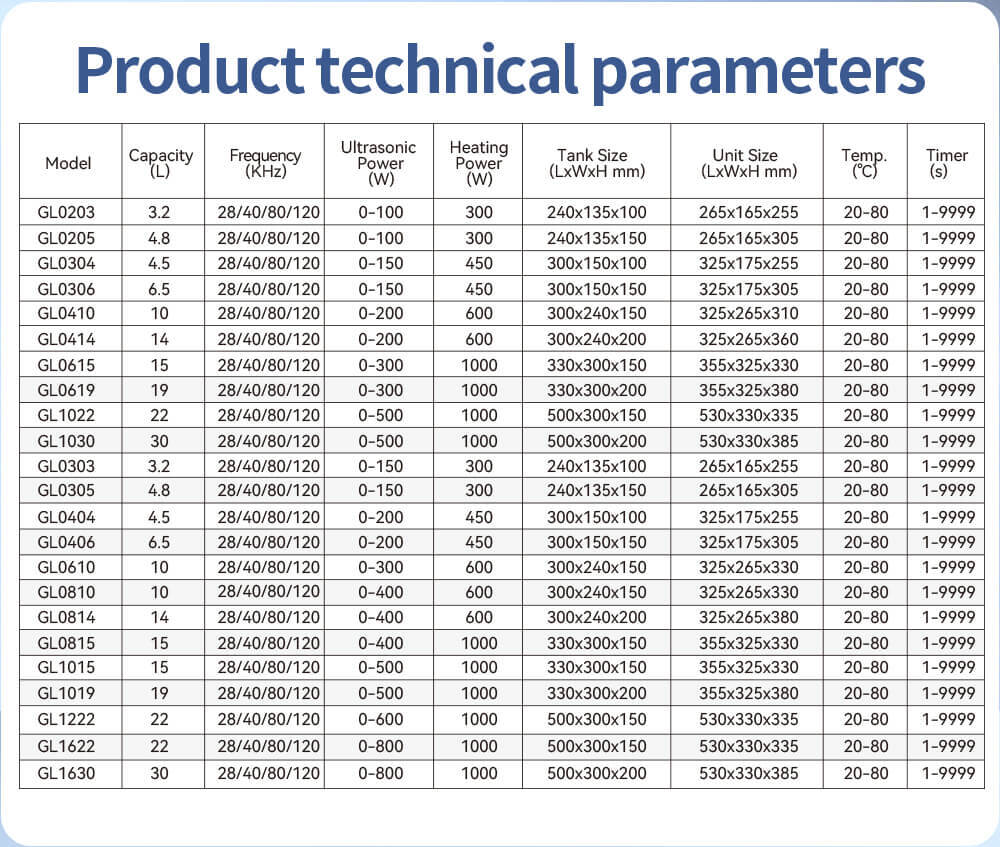
Key Features to Consider When Buying
Selecting the appropriate ultrasonic cleaner requires evaluating multiple technical specifications against your specific hardware cleaning requirements. Prioritizing features based on actual needs prevents overspending on unnecessary capabilities while ensuring the unit handles your workload effectively.
Tank Capacity and Dimensions
Tank volume determines batch size capacity, but internal dimensions matter more than total liters. A 0.8-liter tank measuring 150mm x 100mm x 55mm accommodates longer parts than a 0.8-liter tank with 120mm x 120mm x 60mm dimensions despite identical volumes. Measure your typical hardware components and compare against internal tank dimensions, allowing 25mm clearance on all sides for proper solution circulation.
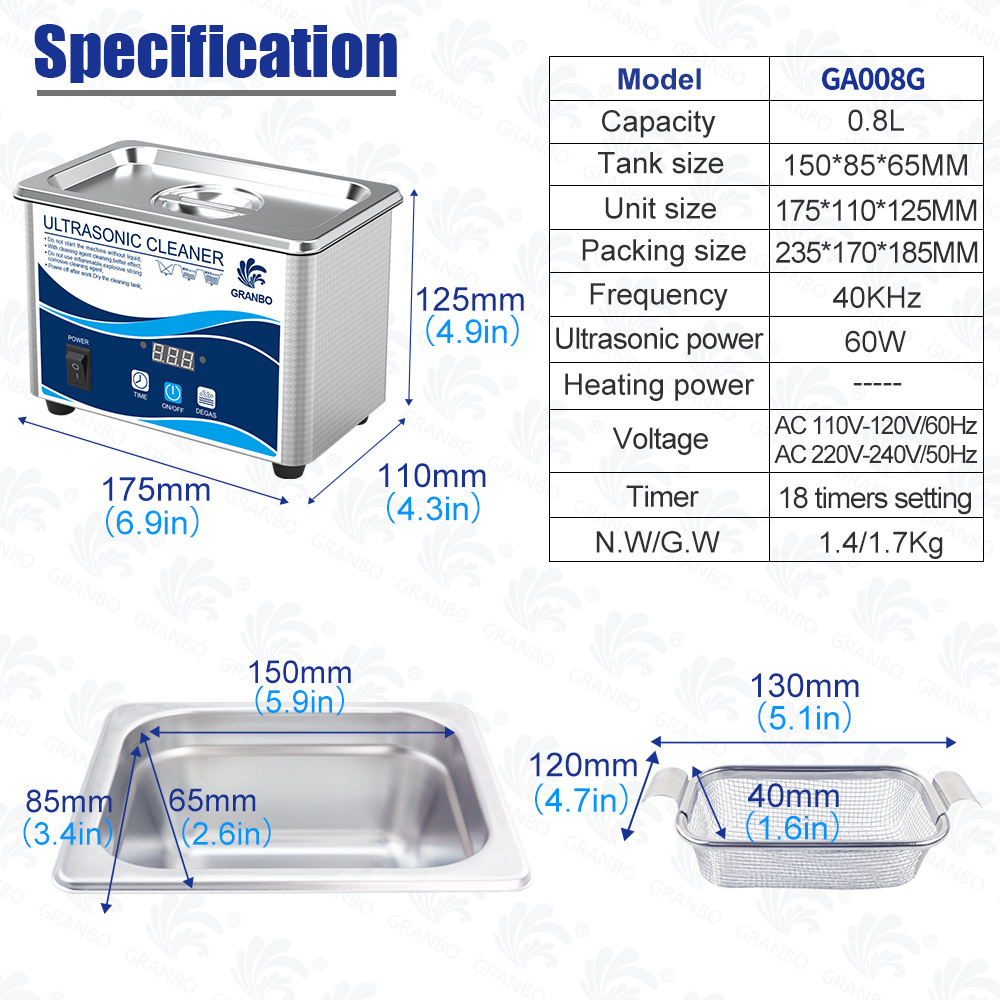
Structure and dimension diagram of the cleaning tank and basket of the Granbo GA008G ultrasonic cleaner
Consider the basket design carefully. Wire mesh baskets suspend parts away from the tank bottom, preventing direct contact with transducers that could damage components or reduce cleaning efficiency. Basket mesh size should retain your smallest hardware while allowing cavitation bubbles to reach all surfaces. Standard mesh sizes range from 3mm for fasteners down to 0.5mm for electronics components.
Multiple basket configurations increase versatility. Some units include divider inserts that separate different hardware types during simultaneous cleaning. Stackable baskets with fine mesh on bottom and coarse mesh on top enable processing mixed part sizes in one cycle. Budget an additional $50 to $200 for supplementary baskets and fixtures when calculating total system cost.
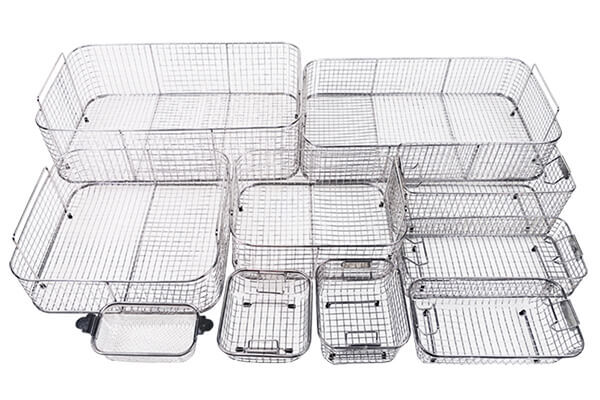
Click to View: Ultrasonic Cleaner Basket
Frequency Settings and Power Output
Operating frequency dramatically affects cleaning performance on different hardware types. Lower frequencies around 25 kHz produce larger, more energetic cavitation bubbles that remove heavy contamination like caked grease, rust scale, and machining chips. These aggressive bubbles can pit soft metals and damage delicate surfaces, making 25 kHz inappropriate for precision components or soft alloys like aluminum.
Higher frequencies near 40 kHz generate smaller bubbles with gentler implosion energy. This provides thorough cleaning of precision parts, electronics, and delicate hardware without surface damage. The tradeoff involves reduced effectiveness against heavy contamination. Parts requiring both aggressive and gentle cleaning benefit from multi-frequency systems that start at 25 kHz then switch to 40 kHz for final processing.
Ultrasonic power density, measured in watts per liter, indicates cleaning intensity more accurately than total wattage alone. Effective hardware cleaning requires minimum power density of 50 watts per liter. Light contamination responds adequately to 50-80 watts per liter. Moderate contamination needs 80-120 watts per liter. Heavy industrial contamination demands 120-150 watts per liter or higher. Calculate power density by dividing ultrasonic wattage by tank capacity in liters.
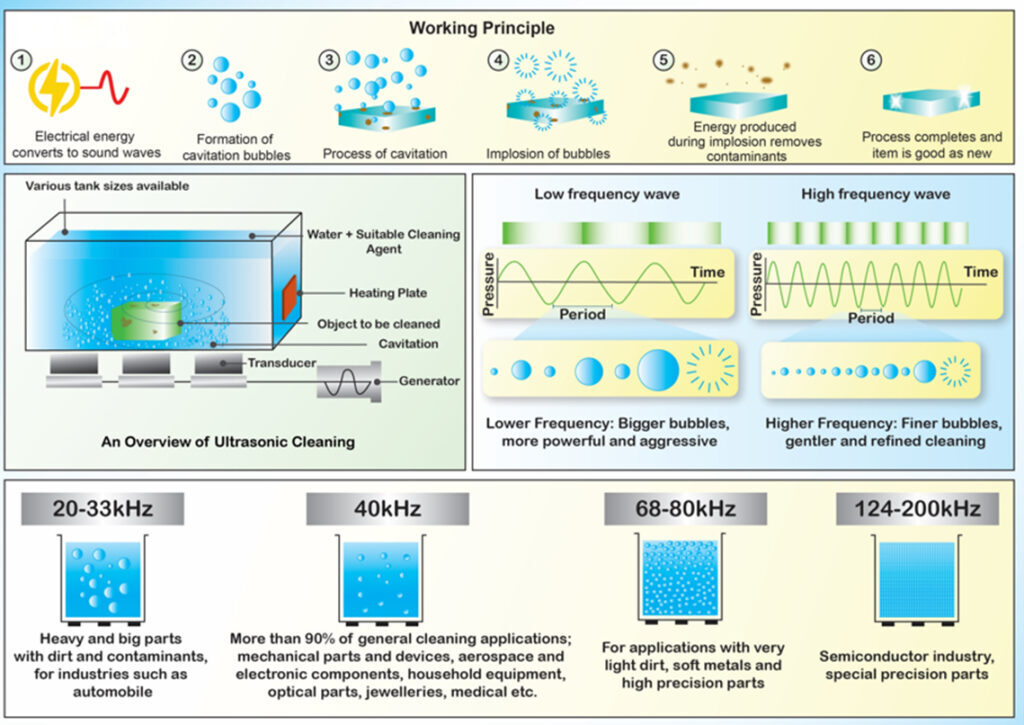
Ultrasonic Frequency Select Guide
Temperature Control Capabilities
Heating dramatically accelerates cleaning action and improves contamination removal. Cold solutions below 20°C clean slowly and incompletely. Optimal temperatures for most hardware applications range between 50°C and 65°C. Higher temperatures approaching 80°C risk damaging certain plastics and can accelerate solution evaporation.
Digital temperature controllers maintain setpoints within plus or minus 2°C, providing consistent results across multiple cleaning cycles. Analog thermostats typically vary plus or minus 5°C, adequate for non-critical applications but problematic when cleaning precision components requiring specific temperature windows. Consider heat-up time specifications, as a 10-liter tank requiring 60 minutes to reach operating temperature wastes considerable production time.
Some hardware materials impose temperature restrictions. Aluminum parts with bonded rubber seals limit maximum temperature to 50°C. Electronics assemblies with plastic connectors may require temperatures below 45°C. Carbide cutting tools tolerate temperatures exceeding 70°C. Match heater capability and control precision to your most temperature-sensitive hardware requirements.
Timer Functions and Automation
Mechanical timers provide basic cycle control, typically adjustable from 1 to 30 minutes in rough increments. These suffice for simple applications with consistent cleaning requirements. Digital timers offer precise settings, often programmable in one-minute or even one-second increments. Some advanced units store multiple programs with different time, temperature, and frequency combinations for various hardware types.
Continuous operation modes allow indefinite running for high-volume production environments. The timer disables automatic shutoff, maintaining ultrasonic action and temperature until manually stopped. This feature proves essential when processing large batches requiring extended cleaning times or when multiple operators share one cleaner throughout a shift.
Auto-restart capability preserves programming after power interruptions. Without this feature, power fluctuations reset the cleaner to default settings, potentially ruining a batch if incorrect parameters resume. Industrial environments with less stable electrical service should prioritize units with memory backup, typically indicated by battery backup or non-volatile memory specifications.
Material Construction and Durability
Tank construction material affects durability and cleaning performance. Stainless steel 304-grade tanks resist corrosion from most cleaning solutions and provide decades of service. Welded construction outperforms glued or mechanically fastened tanks, eliminating leak paths and resonance damping. Tank wall thickness should measure at least 1.0mm for desktop units and 1.2mm for industrial cleaners to withstand cavitation stress without developing fatigue cracks.
Transducer attachment method influences long-term reliability. Permanently bonded transducers using ceramic adhesive or epoxy compounds operate more efficiently than mechanically mounted units. Bonded transducers transfer ultrasonic energy more effectively because no air gap exists between transducer and tank. However, bonded transducers cannot be replaced if they fail, requiring complete tank replacement.
External housing construction ranges from ABS plastic on economy models to powder-coated steel or stainless steel on professional units. Plastic housings crack from impacts and degrade from solvent exposure. Metal housings withstand workshop environments better and provide superior electromagnetic shielding, reducing electrical interference with nearby equipment. Additional housing cost, typically $100 to $300, pays dividends through extended service life in demanding environments.
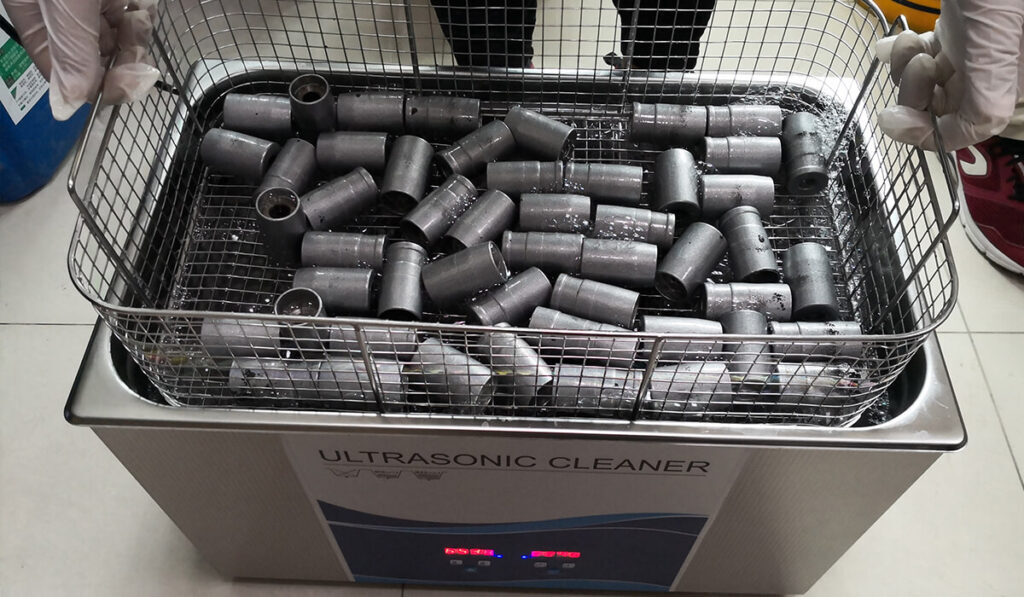
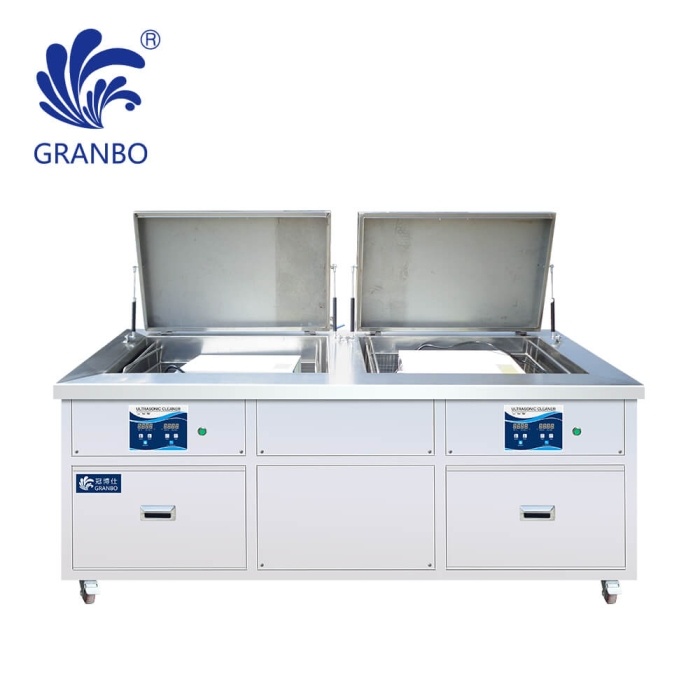
Granbo Industrial Ultrasonic Cleaner
Matching Your Hardware Needs with the Right Machine
Different hardware categories present distinct cleaning challenges requiring specific ultrasonic cleaner capabilities. Matching machine specifications to your predominant hardware type ensures optimal performance and avoids purchasing inadequate or excessive capacity.
Cleaning Small Fasteners and Screws
Small fasteners represent the most common hardware cleaning application. Screws, bolts, nuts, and washers accumulate thread-blocking contamination that prevents proper torque application and causes premature failure. Ultrasonic cleaning restores these components to like-new condition, particularly important for reused fasteners in maintenance applications.
A 3-liter to 6-liter desktop cleaner handles typical small fastener cleaning requirements. Operating frequency should be 28 kHz to 35 kHz, providing sufficient aggression for thread cleaning without excessive noise levels. Power density around 80 watts per liter removes most contamination in 5 to 10 minutes. Heating to 55°C accelerates the process and improves oil removal.
Fine mesh baskets prevent small fasteners from falling through while allowing cavitation bubbles to reach all surfaces. Some technicians use divided baskets to separate different fastener sizes or materials during simultaneous cleaning. Stainless steel fasteners tolerate any cleaning solution, but zinc-plated or cadmium-plated hardware requires pH-neutral solutions to prevent coating damage. Always rinse fasteners thoroughly after ultrasonic cleaning to remove residual cleaning solution that could promote corrosion.
Processing Electronic Components
Electronic hardware demands gentle yet thorough cleaning to remove flux residue, oils, and contaminants without damaging sensitive components. PCB assemblies, connectors, switches, and electromechanical parts require specific ultrasonic parameters and cleaning solutions.
Higher frequencies between 40 kHz and 80 kHz provide necessary gentleness for electronics. Lower frequencies risk damaging wire bonds, dislodging small components, or cracking solder joints. Power density should not exceed 80 watts per liter for populated circuit boards. Unpopulated boards tolerate higher intensities around 100 watts per liter.
Temperature restrictions apply to most electronic assemblies. Plastic connectors, capacitors, and certain semiconductor packages limit maximum temperature to 40°C. Some flux removal solutions perform adequately at room temperature, eliminating heating requirements. Cleaning cycles typically run 3 to 8 minutes, sufficient for flux and contamination removal without prolonged exposure that could damage components.
Water-based electronics cleaning solutions specifically formulated for ultrasonic application work best. These solutions remove flux and ionic contamination while preventing oxidation of exposed metal surfaces. Thorough rinsing with deionized water followed by hot air drying prevents water spots and ensures complete moisture removal from component crevices.
Restoring Tools and Equipment Parts
Tools and equipment parts often require aggressive cleaning to remove heavy contamination accumulated through years of service. Rust, baked-on grease, carbon deposits, and paint overspray resist conventional cleaning methods but respond well to properly configured ultrasonic cleaning.
Larger tank capacity becomes necessary when cleaning tools. A 10-liter to 30-liter cleaner accommodates hand tools, power tool components, and small equipment parts. Lower frequencies around 25 kHz provide the aggressive action needed for heavy contamination. Power density should reach 100 to 150 watts per liter for effective results on stubborn deposits.
Higher temperatures accelerate heavy contamination removal. Operating between 60°C and 70°C softens grease and improves penetration of rust scale. Extended cleaning cycles, often 15 to 30 minutes, allow sufficient time for ultrasonic energy to work through thick contamination layers. Multiple cycles with fresh solution may be necessary for extremely dirty tools.
Alkaline cleaning solutions specifically formulated for metal degreasing work effectively for tool restoration. These solutions cut through oil and grease while providing rust removal capability. However, alkaline solutions attack aluminum, zinc, and certain other metals. Always verify solution compatibility with all materials present in mixed tool batches to prevent chemical damage.